

What is a Respect Order?
Part 1 Chapter 1 Crime and Policing Act 2026.
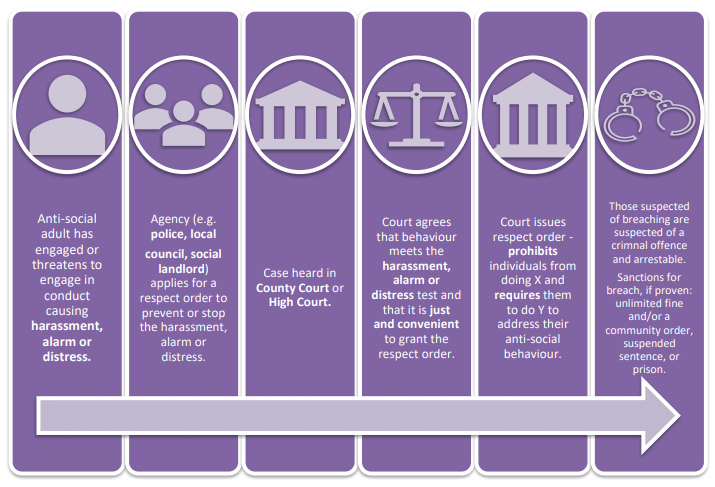
The Respect Order is a new civil court order introduced by the Crime and Policing Act 2026. It is designed to tackle persistent and serious anti-social behaviour by adults and replaces the existing civil injunction (along with Housing and Youth Injunctions).
This order falls under the existing definition of anti-social behaviour in the ASB, Crime and Policing Act 2014, which is:
“Conduct that has caused, or is likely to cause, harassment, alarm or distress to any person.”
What is the legal test?
The court must be satisfied, on the balance of probabilities, that
- The respondent has engaged in or threatens to engage in anti-social behaviour, and
- That it is just and convenient to make the order to prevent further ASB.
“Balance of probabilities” is the civil standard of proof – meaning it is more likely than not that the behaviour has occurred or is threatened.
This is a lower bar than the criminal standard of “beyond reasonable doubt”, which makes it easier to obtain than a criminal conviction.
What types of anti-social behaviour can Respect Orders address?
Respect Orders are flexible and can be used in relation to a wide range of anti-social behaviours, including:
- Neighbour disputes
- Harassment and intimidation
- Vandalism
- Persistent noise nuisance
- Aggressive begging
They should not be used to restrict reasonable behaviour that does not meet the legal test of causing, or being likely to cause, harassment, alarm or distress.
Who can a Respect Order be made against?
Respect Orders can only be made against individuals aged 18 years and over. Applications are made to either the County Court or High Court.
Although Respect Orders apply to adults, practitioners should recognise that some people aged 18-25 may still be transitioning into adulthood and may have specific support, education, housing or welfare needs.
Where appropriate, agencies should consider whether early intervention, support services or diversionary approaches may help address the underlying causes of the behaviour, provided this remains consistent with protecting victims and communities.
Who can apply for a respect order?
Only specific organisations, called “relevant authorities”, can apply for a Respect Order.
These include:
- A local authority
- A housing provider*
- The chief officer of police for a police area
- The chief constable of the British Transport Police Force
- Transport for London
- Transport for Greater Manchester
- The Environment Agency
- The Natural Resources Body for Wales
- The Secretary of State or Welsh Ministers exercising security management functions.
This means individual victims cannot apply themselves – it must be made on their behalf by one of the above agencies.
*A housing provider may only apply if the ASB directly or indirectly relates to or affects its housing management functions.
Putting victims first
When considering whether a Respect Order is appropriate, agencies should consider the impact the behaviour has had on victims, witnesses and the wider community.
Victim and witness evidence can play an important role in demonstrating the harassment, alarm or distress caused by the respondent’s behaviour. Understanding the harm experienced by victims helps agencies determine the most appropriate intervention and ensures that victims remain at the heart of decision-making throughout the process.
Where is the application made?
An application for a Respect Order may be made to the High Court or the County Court.
In most cases applications should be made to the appropriate County Court unless there is a compelling reason to proceed in the High Court.
How long does a Respect Order last?
A Respect Order may:
- Remain in force for a fixed period;
- Continue until further order of the court; or
- Contain different durations for different prohibitions and requirements.
This means the Order can be tailored, for example:
- A prohibition on entering a specific area may last two years.
- A requirement to complete a behavioural programme may last six months.
There is no statutory minimum duration. Applications should clearly specify the duration sought for each prohibition or requirement
Do I need to carry out a risk assessment?
Yes. Before applying for a Respect Order, applicants must complete a risk assessment. This is a statutory requirement.
The assessment should consider:
- The risk posed to victims and communities
- Any vulnerabilities of the respondent
- Alternative methods of preventing the behaviour
- Equality and safeguarding considerations
- Any other relevant factors
Risk assessments help ensure that legal intervention is necessary, proportionate and evidence-based.
You can download the example risk assessment for Respect Orders as seen in the Statutory Guidance Appendix below.
What can a Respect Order do?
A Respect Order can do two things:
Prohibit behaviour
For example, it can prohibit from:
- Contacting a victim
- Entering a specified area
- Associating with certain individuals
- Engaging in particular behaviour
Require positive action (positive requirements)
For example:
- Engaging with support services
- Completing behavioural programmes
- Attending substance misuse treatment
- Participating in anger management or educational programmes
Note on positive requirements
Any positive requirement included in a Respect Order must be practical and capable of being monitored. The court will expect clarity regarding who will supervise compliance and how any breach or non-compliance will be reported.
Any requirements or prohibitions must, so far as practicable:
- Avoid interfering with the respondent’s employment or education; and
- Not conflict with any other court order to which they are subject.
This combination of restrictions and positive requirements is one of the key differences between the Respect Order and the old civil injunction, which could only prohibit behaviour.
What happens if a respect order is breached?
Breach of a Respect Order is a criminal offence.
This is a major shift from the old civil injunction, where breach was not automatically criminal. The Respect Order changes this fundamentally – if a perpetrator breaches the order, the consequences include:
- Immediate arrest by police
- Criminal penalties, including:
-
- Fine
- Imprisonment (for the most serious or persistent breaches – up to 2 years)
- Both of the above
-
FAQs
Yes, but only in specific cases.
A Respect Order may exclude the respondent from the place where they normally live only if
- The application is made by a local authority, the chief officer of police, or – if the premises are owned or managed by a housing provider – that housing provider, and
- The court considers that the ASB involves or threatens violence against other persons, or that there is a significant risk of harm to other persons from the respondent.
This allows removal of a perpetrator from their home where necessary to protect victims or neighbours.
This is considered a serious intervention, and courts will carefully assess whether exclusion is proportionate and necessary. The guidance makes clear that exclusion should generally only be used in the most serious cases.
Yes.
The court may vary or discharge a Respect Order following an application from either the applicant or the respondent.
The court may:
- Add a prohibition or requirement
- Remove a prohibition or requirement
- Amend existing wording
- Extend a duration
- Reduce a duration
This allows orders to be adapted as circumstances change or where different interventions become necessary.
The Home Office states:
“There are key differences between Respect Orders and the previous ASBO. Unlike ASBOs, the Respect Order will apply to adult ASB offenders only, it will be issued by the civil courts and will include the option to attach rehabilitative positive requirements (that is, requiring the individual to undertake activity to address the underlying causes of their behaviour) as well as prohibitions.”
The court may make an Interim Respect Order while a full application is being considered.
Interim Orders provide immediate protection pending a final hearing.
Importantly, an Interim Respect Order can only contain prohibitions and cannot include positive requirements.
Yes. However, applicants should first consider whether varying an existing Order would achieve the desired outcome. Any multiple Orders should be compatible and easy for the respondent to understand and comply with.
No. Respect Orders are civil orders and can be granted on the civil standard of proof, known as the “balance of probabilities”. A criminal conviction is not required.
Yes. Depending on the circumstances, a Respect Order may be used alongside other interventions and enforcement tools. Agencies should consider the most appropriate and proportionate response based on the behaviour, risk, and impact on victims.
Need training?
We offer expert-led training on Respect Orders and wider ASB powers to help practitioners build confidence and achieve better outcomes for victims.
Read more about our training offers here: